Infection Control & Isolation Precautions for the NCLEX
Infection control NCLEX questions test your ability to prevent the spread of pathogens while prioritizing patient safety. You must master the differences between Standard, Contact, Droplet, and Airborne precautions, knowing exactly when to use a surgical mask versus an N95 respirator or when a private room is mandatory.
The Foundation: Standard Precautions for Every Client
Think of Standard Precautions as your default setting for every single patient interaction, regardless of their diagnosis. In the eyes of the NCLEX, every client's blood, body fluids, non-intact skin, and mucous membranes are potentially infectious. You aren't just washing your hands; you are performing hand hygiene before and after every patient contact. If you anticipate a splash—perhaps during a wound irrigation for a patient with a 102.4°F fever and an elevated WBC count of 18,000/mm³—you must proactively reach for a gown and face shield. Standard precautions are the primary defense against healthcare-associated infections (HAIs) and are the first step in the chain of infection.
Donning and Doffing: The Order Matters
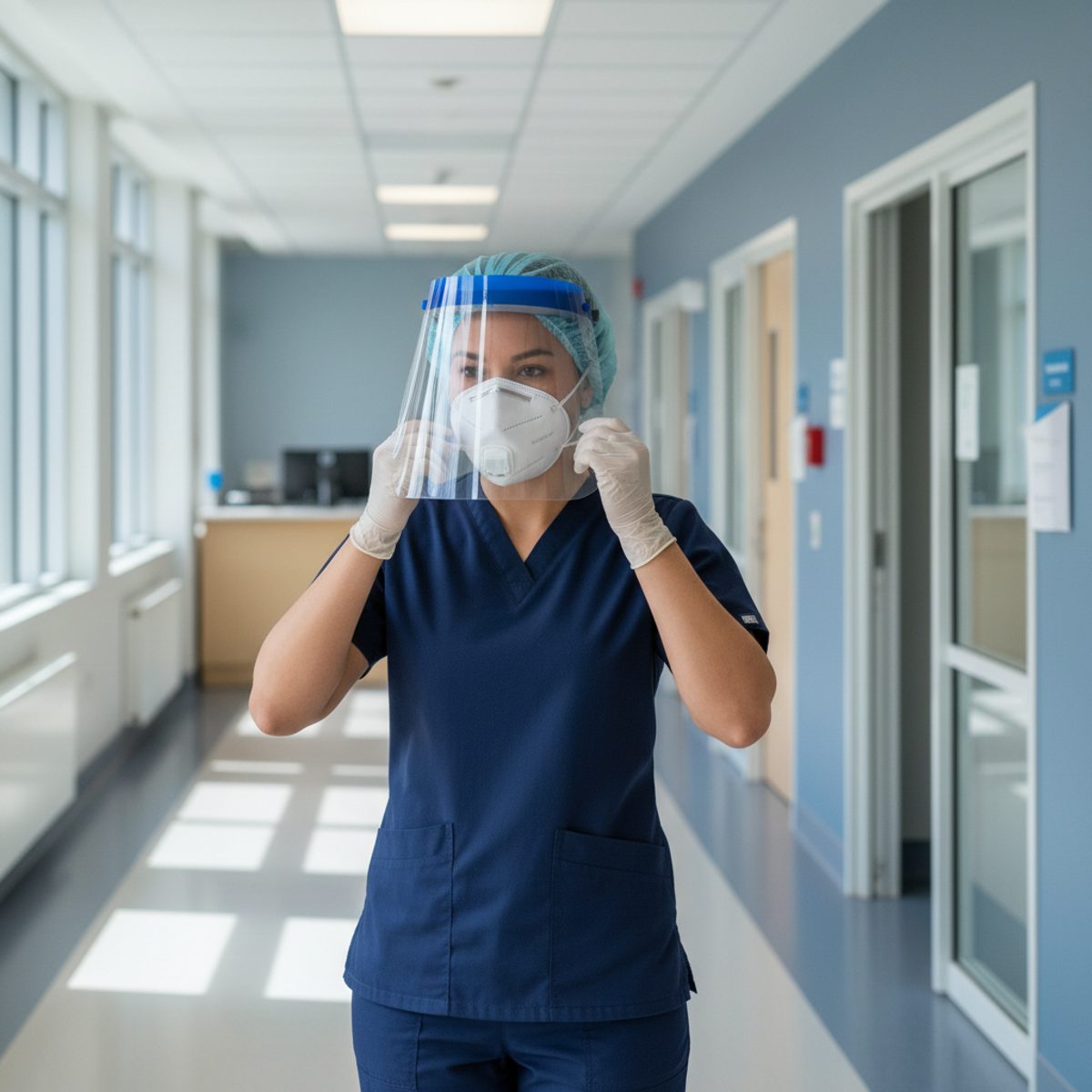
The NCLEX loves to test the specific sequence of putting on and taking off personal protective equipment (PPE). When donning, you start from the bottom up (mostly): Gown, Mask, Goggles/Face Shield, and then Gloves. However, the doffing sequence—where you are most likely to contaminate yourself—is critical. You usually remove PPE in alphabetical order: Gloves, Goggles, Gown, and Mask. Remember, the mask is always the last thing to come off, especially in airborne scenarios, and it must be removed outside the room to prevent inhaling lingering droplets. If you touch the front of your contaminated gown while removing it, you've just failed the safety component of the task.
Contact Precautions: Dealing with the 'Touchables'
Contact precautions are triggered by organisms spread by direct or indirect touch. You'll see this most often with MDROs (Multi-Drug Resistant Organisms) like MRSA or VRE, and enteric pathogens like C. diff. Imagine you are assigned to a 68-year-old client with watery diarrhea and a positive C. diff toxin stool culture. Your priority is a private room and dedicated equipment, like a dedicated stethoscope and blood pressure cuff that stays in the room. Crucially, C. diff spores are resistant to alcohol-based hand rubs. You must use soap and water for hand hygiene. If the question asks about a patient with an open, draining MRSA wound, you need a gown and gloves every time you enter that environment, even if you aren't providing direct care, because the environment itself is considered contaminated.
Droplet Precautions: The Five-Foot Rule
Droplet precautions are for pathogens that travel in large respiratory particles—think of them as heavy 'wet' drops that fall to the ground within 3 to 6 feet of the source. Common NCLEX culprits include Neisseria meningitidis, Influenza, and Pertussis. If you are caring for a child with a barking cough and suspected Pertussis, your primary intervention is a surgical mask and a private room. Unlike airborne pathogens, these droplets don't stay suspended in the air for hours. However, if you are transporting a patient on droplet precautions, the client must wear a surgical mask. Keep in mind that for bacterial meningitis, the patient stays on these precautions until 24 hours after starting effective antibiotic therapy. Watch for vitals like a high fever (103.1°F) and neck stiffness, which should trigger an immediate droplet protocol.
Airborne Precautions: The Tiny Invaders
Airborne precautions are for the 'small' players that stay suspended in the air: Measles, Varicella (Chickenpox/Disseminated Herpes Zoster), and Tuberculosis (TB). These require the big guns. You must have a private, negative-pressure room with at least 6 to 12 air exchanges per hour. As the nurse, you must wear a fit-tested N95 respirator. If a client presents with a productive cough, night sweats, and a chest X-ray showing upper lobe infiltrates, you don't wait for the sputum culture results to show Acid-Fast Bacilli (AFB); you implement airborne precautions immediately based on suspicion. Note that if a patient has Varicella, they require both Airborne AND Contact precautions until all lesions have crusted over, as the fluid in the vesicles is highly infectious.
Protective Environment: Shielding the Vulnerable
Sometimes, the goal isn't to keep the patient's germs in, but to keep the world's germs out. This is a Protective Environment (formerly Neutropenic Precautions). You’ll see this with hematopoietic stem cell transplant recipients or oncology patients with an Absolute Neutrophil Count (ANC) below 500 cells/mm³. In this scenario, the room has positive pressure, and the patient must wear a mask when leaving the room. Clinical interventions focus on eliminating reservoirs of bacteria: no fresh flowers, no raw fruits or vegetables, and strictly avoiding sick visitors. If your patient has a temperature of 100.4°F (38°C) while neutropenic, this is a medical emergency. You are the gatekeeper of their fragile immune system, and every break in technique increases their risk of life-threatening sepsis.
Prioritizing Room Assignments
The NCLEX loves to give you four patients and only one private room. Who gets it? The rule of thumb: prioritize the patient who is the most infectious or the most immunocompromised. A patient with active TB always gets a private room over a patient with a stable VRE infection. If you must cohort (place two patients in the same room), they must have the same organism. You cannot place a patient with RSV in the same room as a patient with Influenza. Additionally, you cannot cohort an infected patient with a patient who is post-operative or immunocompromised. For example, a client with a fresh hip replacement and a hemoglobin of 9.2 g/dL should never share a room with someone who has an active MRSA infection.
Medical vs. Surgical Asepsis
Distinguishing between 'clean' and 'sterile' is vital for safety questions. Medical asepsis (clean technique) aims to reduce the number of organisms and is used for things like medications, tube feedings, and daily hygiene. Surgical asepsis (sterile technique) aims to eliminate all microorganisms. You use this for Foley catheter insertion, central line dressing changes, and surgical procedures. If a sterile field is touched by a non-sterile object, or if you turn your back on it, it is contaminated. On the exam, if you see a nurse reach over a sterile field or use a bottle of sterile saline that was opened 48 hours ago, the correct answer usually involves stopping the procedure and starting over with new, sterile supplies.
Key takeaway
Infection control isn't just about memorizing lists; it's about developing a 'safety first' mindset that protects both you and your patients. When you sit for the NCLEX, visualize the room, the PPE, and the specific ways a pathogen moves. If you can master these precautions and the rationale behind them, you'll be well-prepared for any safety and infection control questions that come your way. For more deep dives into high-yield topics and practice questions that mirror the real exam, keep studying with us at NCLEXVault.
Frequently asked questions
What is the most important step in infection control NCLEX questions?
Hand hygiene is consistently the 'most important' or 'first' step in preventing the spread of infection. Whether it is before donning PPE, after doffing PPE, or between patients, hand hygiene is the gold standard. On the NCLEX, if you are faced with a choice between putting on gloves and washing your hands before a non-invasive procedure, hand hygiene is your priority. Remember to use soap and water specifically for C. diff or when hands are visibly soiled.
How do I remember which diseases are Airborne?
Use the mnemonic 'Airborne MTV': M for Measles, T for Tuberculosis, and V for Varicella (including disseminated shingles). These three are the heavy hitters on the NCLEX. Remember that they all require a negative-pressure room and an N95 respirator for staff. If a client with one of these must be transported, they wear a regular surgical mask, not an N95, to contain their secretions at the source.
When is a gown required for Contact Precautions?
A gown is required whenever you anticipate that your clothing will come into contact with the patient or potentially contaminated environmental surfaces. For the NCLEX, assume that any entry into a Contact Precaution room (like for MRSA or VRE) requires both a gown and gloves. Even if you are just checking an IV pump, the environment is considered contaminated, and your scrubs can pick up pathogens that you'll then carry to the next patient.
What is the difference between a surgical mask and an N95?
A surgical mask protects against large droplets (Droplet Precautions) and is worn to prevent the spread of germs from the wearer's mouth and nose. An N95 respirator is a specialized device that filters out at least 95% of very small airborne particles. The N95 requires a 'fit test' to ensure a tight seal around the face. On the NCLEX, if a patient has TB, you need an N95; if they have the flu, a surgical mask is sufficient.
Can I cohort a patient with a clean wound and an infected patient?
No. Never cohort an 'infected' or 'colonized' patient with a 'clean' patient (such as a post-op patient or someone with an open incision). The risk of cross-contamination is too high. If you must cohort two patients in a semi-private room, they must be infected with the same exact organism (e.g., two patients with the same strain of Influenza) and have no other contraindicating infections.