Nursing Care Plan Examples: Write One in 20 Minutes
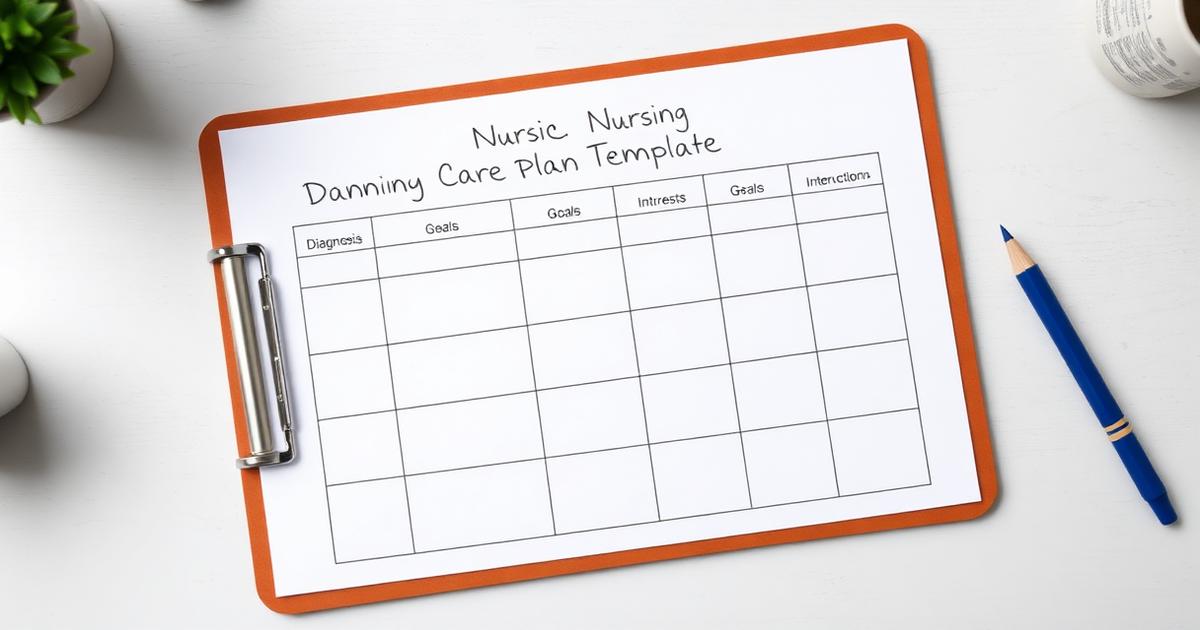
A care plan is the nursing process written down: assess, diagnose, plan, implement, evaluate. Once you see that, the blank form stops being intimidating.
Step 1 — cluster your assessment data
Group subjective and objective findings that point the same direction. Crackles, dyspnea, oxygen saturation 88% and a productive cough all cluster into one airway problem, not four.
Step 2 — pick the diagnosis in three parts
Problem related to cause as evidenced by data. Impaired gas exchange related to alveolar-capillary membrane changes as evidenced by SpO2 88% and crackles bilaterally. Never use a medical diagnosis as the cause.
Step 3 — write goals that are measurable and timed
Client will maintain SpO2 above 92% on 2 L nasal cannula within 4 hours. Not client will breathe better. If you cannot chart yes or no against it, it is not a goal.
Step 4 — interventions with rationales
Every intervention gets a why. Elevate the head of bed to 45 degrees to improve lung expansion and reduce work of breathing. Three to five interventions is plenty when each one has a defensible rationale.
Step 5 — evaluate honestly
Met, partially met or not met, with the data that proves it, plus what you would change. Instructors grade this section hardest and students rush it most.
Second worked example
Acute pain related to surgical incision as evidenced by a reported pain score of 8/10 and guarding. Goal: pain reported at 3/10 or lower within 60 minutes of intervention. Interventions: assess pain characteristics every hour, administer prescribed analgesic and reassess in 30 minutes, position for comfort, apply nonpharmacologic measures. Rationales tie each action to physiology or safety.
Demystifying the Care Plan: Why Speed Matters in Clinicals
If you're like most nursing students I mentor, the mere mention of care plans makes your stomach drop. You probably picture yourself staying up until 2:00 AM, surrounded by empty coffee mugs and five-pound NANDA textbooks, agonizing over every single word. I want to let you in on a little clinical secret: it doesn't have to be this torturous. Once you learn to see these assignments as practical, clinical roadmaps rather than tedious academic hoops to jump through, you can easily draft a solid, high-scoring plan in under twenty minutes. By leveraging a structured nursing process care plan, you will streamline your clinical thinking, protect your sanity, and deliver safer, more efficient patient care during your shifts.
Grounding Your Plan in the Five-Step Nursing Process
To write a care plan quickly, you must rely on the classic five-step nursing process care plan: Assessment, Diagnosis, Planning, Implementation, and Evaluation (ADPIE). Think of ADPIE not as five separate, daunting tasks, but as a continuous loop of clinical reasoning. You don't need to reinvent the wheel every time you walk into a patient's room. Instead, you just need to observe, label the problem, set a target, take action, and check if your action worked. When you frame your charting around this logical progression, the clinical picture practically writes itself, saving you from the dreaded writer's block that strikes when looking at a blank template.
Rapid Assessment: Spotting the Red Flags
Let's put this into practice with a concrete clinical example. Imagine your patient, Mr. Davis, is a 68-year-old admitted with acute decompensated heart failure. During your morning assessment, you note bilateral 2+ pitting pedal edema, wet crackles in his lower lung fields, a respiratory rate of 24 breaths per minute, and an oxygen saturation of 89% on room air. He is currently ordered to receive furosemide 40 milligrams intravenously. This cluster of subjective and objective data is your raw material. Instead of writing down dozens of random facts, focus strictly on these abnormal findings because they immediately pinpoint your patient's highest-priority physiological needs.
Crafting Your Diagnosis Without Flipping Through Books for Hours
Now, let's translate these assessment findings into a formal nursing diagnosis. Students often get bogged down looking at endless lists of nursing diagnosis examples, but you can simplify this using the classic Problem-Etiology-Symptom (PES) format. For Mr. Davis, your diagnosis would be: Fluid Volume Excess related to compromised regulatory mechanisms as evidenced by bilateral pedal edema, crackles in the lungs, and an SpO2 of 89%. Notice how this clearly connects the medical condition to the nursing problem and justifies it with your physical assessment. Using standardized nursing diagnosis examples keeps your language precise and instantly communicates the patient's urgent needs to the entire healthcare team.
Writing SMART Goals That Actually Make Sense
Once your diagnosis is set, you need to establish measurable goals, also known as the planning phase. The gold standard here is writing SMART goals: Specific, Measurable, Attainable, Realistic, and Timed. Never write a vague goal like 'the patient's breathing will improve.' Instead, try: 'The patient will maintain an oxygen saturation of 92% or higher on room air within four hours of receiving intravenous furosemide.' This goal is excellent because it specifies the exact metric, the intervention context, and a clear deadline. Having a concrete time frame ensures you can objectively evaluate your patient's progress later in your shift.
Selecting High-Impact Interventions That Clinical Instructors Love
Next, you need to choose evidence-based nursing interventions to achieve your goal. For our fluid overload patient, your interventions should directly address his respiratory distress and fluid retention. First, elevate the head of the bed to a semi-Fowler's position to maximize lung expansion. Second, administer the ordered 40 milligrams of IV furosemide and closely monitor his urine output over the next two hours. Third, monitor his serum potassium levels, keeping in mind that loop diuretics can cause hypokalemia, and notify the provider if his level drops below 3.5 milliequivalents per liter. These concrete, physiological interventions demonstrate safe clinical judgment to your instructors.
Learning from Real-World Nursing Care Plan Examples
As a busy student, you shouldn't start every assignment from scratch. Reviewing pre-written nursing care plan examples is one of the fastest ways to build your clinical vocabulary and recognize recurring diagnostic patterns. When you study high-quality nursing care plan examples, pay close attention to how experienced nurses link specific assessment data to corresponding interventions. You will start to notice that certain diagnoses, like Impaired Gas Exchange or Risk for Falls, almost always share the same core interventions and rationales. Analyzing these professional examples helps train your brain to think like a seasoned nurse, drastically cutting down your writing time.
How to Build a Care Plan Template Nursing Students Can Reuse
To consistently write these plans in twenty minutes or less, you need a reliable care plan template nursing schools approve of. I highly recommend organizing your template into five distinct columns: Assessment, Diagnosis, Planning, Implementation, and Evaluation. By keeping a digital care plan template nursing file saved on your laptop, you can quickly plug in your patient's specific lab values, like a high creatinine or a low hemoglobin, and select relevant interventions from a pre-saved list. This systematic approach transforms a stressful, chaotic writing process into a simple, structured plug-and-play exercise, leaving you with more time to focus on mastering your actual clinical skills.
Key takeaway
Mastering the nursing process care plan doesn't have to be an exhausting, all-night ordeal if you utilize a structured template and study established nursing care plan examples. By focusing on your patient's most urgent physiological priorities and using a systematic approach, you can draft highly effective, top-tier clinical care plans in under twenty minutes. Keep practicing this streamlined method, and you'll build the strong clinical judgment skills needed to ace both school and the NCLEX.
Frequently asked questions
What is the fastest way to write a nursing care plan?
The fastest way to write a nursing care plan is to use a structured care plan template nursing students can easily adapt. Start by identifying the single highest-priority clinical issue from your assessment, such as an abnormal lab value or respiratory distress. Focus your entire plan around this primary problem instead of trying to address every minor symptom. Using pre-established nursing care plan examples as a guide will help you quickly plug in standard interventions and rationales.
How do I choose the right nursing diagnosis?
Choose your nursing diagnosis by looking at your patient's most critical physiological needs first, following Maslow's Hierarchy of Needs. Look at your assessment data and find the most significant airway, breathing, or circulation issues. Once you identify the top priority, use reliable nursing diagnosis examples to frame the problem, link it to the pathophysiology, and list your subjective or objective evidence to justify your choice.
What is the difference between a medical diagnosis and a nursing diagnosis?
A medical diagnosis focuses on a specific disease process or pathology, such as diabetes mellitus or pneumonia, which is treated by a physician. In contrast, a nursing diagnosis, central to any nursing process care plan, focuses on the human response to that medical condition. For example, while a physician diagnoses pneumonia, a nurse diagnoses Impaired Gas Exchange related to alveolar-capillary membrane changes, directing independent nursing interventions.
Why do nursing clinical instructors emphasize care plans so much?
Instructors emphasize care plans because they are the ultimate tool to teach and evaluate clinical reasoning. Writing a care plan forces you to synthesize assessment data, prioritize patient needs, select evidence-based interventions, and evaluate outcomes. It teaches you to think systematically on your feet during a busy shift. Relying on a standard care plan template nursing students use helps you organize this critical thinking process clearly for grading.
Can I use templates for my clinical care plans?
Absolutely. Using a care plan template nursing students rely on is a highly efficient way to organize your thoughts and ensure you do not miss critical steps in the ADPIE process. While your template structure can remain the same, always customize the specific patient data, medications, and clinical goals to match your assigned patient's unique physiological status and needs during that specific clinical shift.