ABG Interpretation the Tic-Tac-Toe Way (in 20 Seconds)
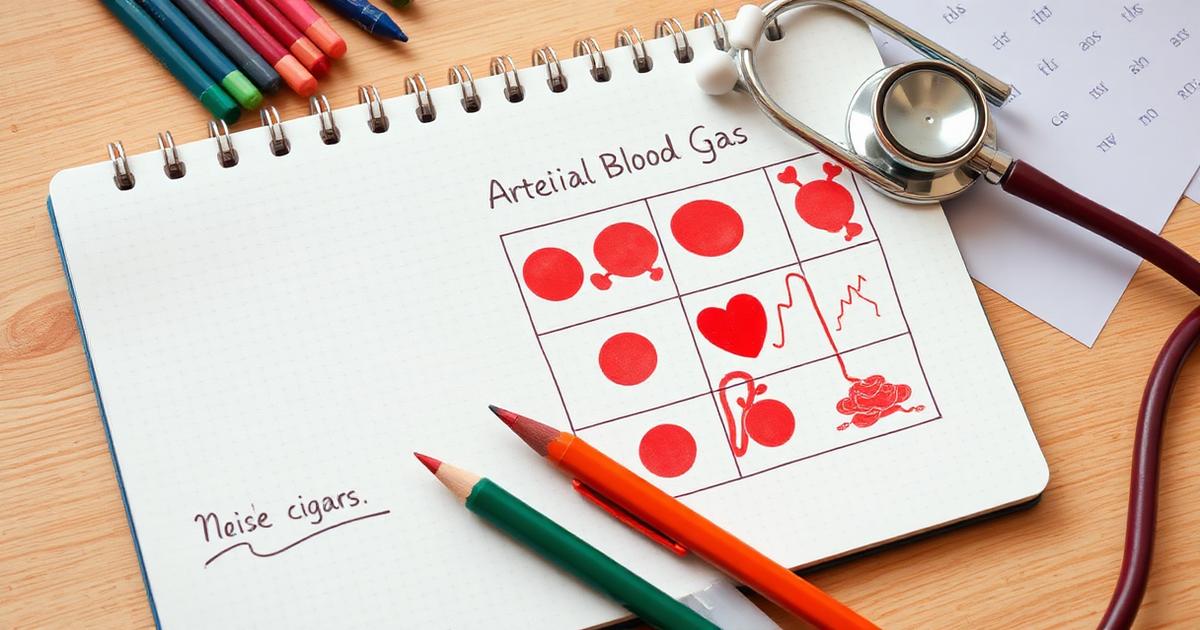
Arterial blood gases show up on nearly every NCLEX practice test and confuse most candidates. The Tic-Tac-Toe method turns them into a 20-second decision.
Step 1 — draw the grid
Three columns: Acid | Normal | Base. Three rows: pH | PaCO₂ | HCO₃.
Step 2 — plot the values
pH: acid if < 7.35, normal 7.35–7.45, base if > 7.45. PaCO₂: acid if > 45, normal 35–45, base if < 35 (note: CO₂ is inverted — high = acid). HCO₃: acid if < 22, normal 22–26, base if > 26.
Step 3 — read the line
The pH names the disorder (acidosis vs alkalosis). Whichever of PaCO₂ or HCO₃ lines up with the pH names respiratory (PaCO₂) or metabolic (HCO₃).
Step 4 — check compensation
If the other value is normal → uncompensated. If it moved in the opposite direction from the pH → partially compensated. If pH is normal and both PaCO₂ and HCO₃ are off → fully compensated.
Worked example
pH 7.28, PaCO₂ 52, HCO₃ 24 → acidosis (pH), respiratory (CO₂ matches), uncompensated (HCO₃ normal). Answer: uncompensated respiratory acidosis.
Mastering ABGs Without the Panic
Hey future nurses! Let’s talk about one of those topics that instantly makes nursing students hold their breath: arterial blood gas nursing. If you've ever looked at a set of lab values and felt your own heart rate spike, you are definitely not alone. ABGs can feel incredibly overwhelming when you try to memorize complex physiological pathways under the ticking clock of an exam. But what if I told you that you could master ABG interpretation NCLEX style in less time than it takes to flush an IV line? It is entirely possible when you use the tic tac toe ABG method. Let’s break down this beautiful, visual shortcut together so you can walk into your next exam-and your future clinical shifts-with absolute confidence.
The Players: Memorizing the Normal Values
Before we can play the game, we need to know our players. In arterial blood gas nursing, everything boils down to three primary values: pH, PaCO2, and HCO3. You absolutely must commit these normal ranges to memory, but don't worry, they are easy to remember. Normal pH is 7.35 to 7.45. PaCO2, which represents our respiratory component, conveniently mirrors those decimals at 35 to 45 mmHg. Lastly, HCO3, our metabolic/bicarbonate component, is normally 22 to 26 mEq/L. Think of pH as the ultimate boss that determines if the body is in acidosis or alkalosis. If the pH drops below 7.35, we are acidic; if it climbs above 7.45, we are basic or alkaline. Keeping these baseline numbers locked in your brain is your golden ticket to rapid ABG interpretation NCLEX success.
Setting Up Your Tic-Tac-Toe Grid
Now, let’s set up the game board! Grab a blank piece of scrap paper-the kind you get during your nursing exams. Draw a standard 3x3 tic-tac-toe grid. At the very top of your columns, write 'ACID', 'NORMAL', and 'BASE' (or 'ALKALINE') from left to right. This simple grid is going to do all the heavy mental lifting for you, saving you precious seconds and preventing those classic test-taking brain-fades. The magic of the tic tac toe ABG method is that it translates abstract, confusing laboratory data into a simple visual puzzle. Once your board is drawn, you are ready to start placing your values and watching the pattern reveal itself.
Step 1: Placing the pH Value
First up to bat is our pH. Look at the pH value on your exam question. If the pH is normal (between 7.35 and 7.45), you will write the word 'pH' in the 'NORMAL' column. If the pH is less than 7.35, write 'pH' under the 'ACID' column. If it is greater than 7.45, write 'pH' under the 'BASE' column. This step is crucial because the column where your pH lands will ultimately name the primary imbalance. It tells us whether we are dealing with acidosis or alkalosis. As a nurse, identifying this primary state is your first major clue in clinical decision-making, helping you understand how the patient's underlying physiology is currently behaving.
Step 2: Placing the Respiratory Component (PaCO2)
Next, we have to place our PaCO2, and here is where many students get tripped up, so pay close attention! PaCO2 is regulated by the lungs, making it our respiratory indicator. Remember that carbon dioxide is an acid. Therefore, a high PaCO2 (greater than 45) means the blood is more acidic, so you will write 'PaCO2' in the 'ACID' column. Conversely, a low PaCO2 (less than 35) means less acid, making the environment basic, so you write 'PaCO2' in the 'BASE' column. If it's normal, place it in the 'NORMAL' column. This 'flip' is where the tic tac toe ABG strategy shines, because it visually corrects the inverse relationship of CO2, preventing silly transposition errors.
Step 3: Placing the Metabolic Component (HCO3)
Now let's place our metabolic player, HCO3 (bicarbonate). Bicarbonate is regulated by the kidneys and acts as a base. Because it behaves logically, there are no tricky flips to worry about here! A low HCO3 (less than 22) means we don't have enough base, making the body acidic, so place 'HCO3' in the 'ACID' column. A high HCO3 (greater than 26) means we have an excess of base, so write 'HCO3' in the 'BASE' column. If it falls nicely within the 22 to 26 range, place it under 'NORMAL'. This completes your board setup, and you are officially ready to find your winning line!
Step 4: Finding the Winner
Here is where the magic happens and you get your answer in under 20 seconds. Look at your completed board. You are looking for three items in a vertical or diagonal row-just like real tic-tac-toe! Look at which value ('PaCO2' or 'HCO3') is in the same column as your 'pH'. If 'pH' and 'PaCO2' are in the 'ACID' column together, you have a vertical match: Respiratory Acidosis. If 'pH' and 'HCO3' are in the 'BASE' column together, you have Metabolic Alkalosis. The matching component names the system (Respiratory or Metabolic), and the column header names the state (Acidosis or Alkalosis). It is that simple! This rapid ABG interpretation NCLEX trick removes all the second-guessing.
Solving the Mystery of Compensation
But wait, what if the pH is in the normal column but the other values are abnormal? This is where we look at compensation. If your pH is normal, but both PaCO2 and HCO3 are abnormal and on opposite sides, the body is fully compensating. Whichever side of 7.40 (the absolute middle of normal) the pH leans toward tells you the original culprit. If the pH is abnormal and all three parameters are in different columns, you are looking at partial compensation because the opposing system is trying to fix the issue but hasn't succeeded yet. If the opposing system hasn't started helping at all (it's still in the 'NORMAL' column), it is uncompensated. This visual grid makes teaching arterial blood gas nursing compensation incredibly intuitive.
Nailing Your Next Exam
Mastering this quick technique is a total game-changer for your test-prep strategy. On the NCLEX, you will be faced with multiple-choice questions where time is of the essence and anxiety is running high. Having a systematic, reliable tool like the tic tac toe ABG method keeps you grounded. It takes away the panic of staring at random numbers and replaces it with a structured, step-by-step game. Practice this grid on twenty different practice questions, and you will find yourself solving them in 20 seconds flat. Keep practicing, believe in yourself, and remember that every expert nurse sat exactly where you are sitting right now. You've got this!
Key takeaway
The tic-tac-toe method turns terrifying ABG questions into a simple visual game. By memorizing your normal values and mapping out your ACID, NORMAL, and BASE columns, you can accurately solve any standard NCLEX ABG question in under 20 seconds without second-guessing yourself.
Frequently asked questions
What is the normal range for key ABG values?
For nursing exams, memorize these three key baseline ranges: pH is 7.35 to 7.45; PaCO2 (respiratory component) is 35 to 45 mmHg; and HCO3 (metabolic component) is 22 to 26 mEq/L.
How do I know if an ABG is respiratory or metabolic?
Using the tic-tac-toe method, look at which indicator matches the column of your pH. If PaCO2 is in the same column as your pH, it is a respiratory issue. If HCO3 is in the same column as your pH, it is a metabolic issue.
What is the difference between partial and full compensation?
In full compensation, the pH has returned to its normal range (7.35–7.45), while both PaCO2 and HCO3 remain abnormal. In partial compensation, the pH is still abnormal, but the opposing system has also gone abnormal to try and correct the pH.
Why does a high PaCO2 go in the Acid column on the grid?
Carbon dioxide (CO2) acts as an acid in the human body. When PaCO2 is high (greater than 45 mmHg), it makes the blood more acidic, which is why it is placed in the 'ACID' column on your tic-tac-toe grid.
Can I use the tic-tac-toe method for mixed acid-base disorders?
The tic-tac-toe method is perfect for simple and compensated acid-base imbalances, which cover the vast majority of NCLEX questions. For complex, mixed acid-base disorders often seen in critical care, you will need to perform a deeper physiological analysis.